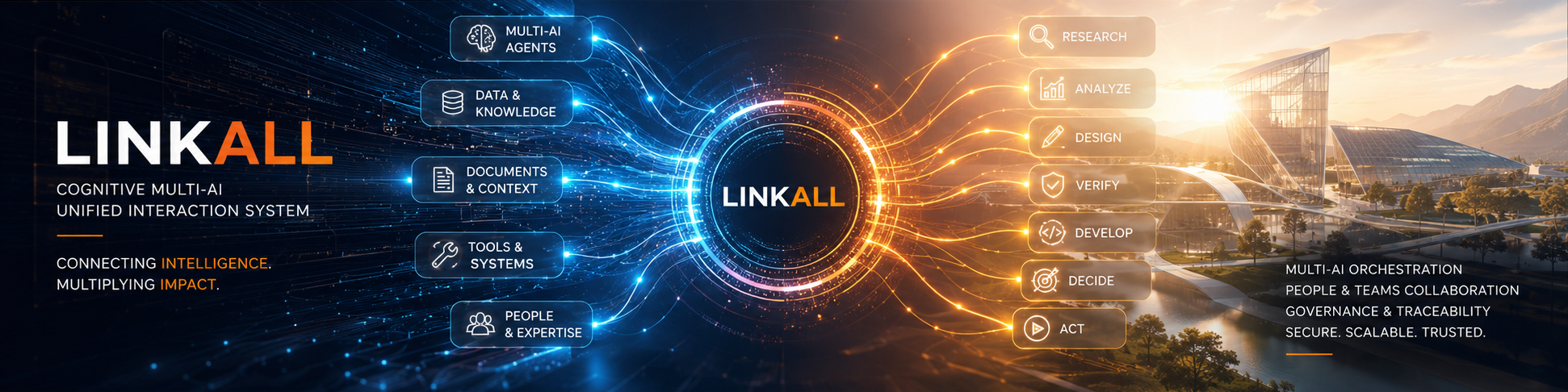
The cognitive environment where people and artificial intelligences work together
LINKALL™ coordinates multiple artificial intelligence systems, software agents, people, data, documents and operational tools within a single persistent, governed environment. From personal research to team management, from scientific and engineering design to the optimization of industries, airports and multinational organizations, it grows with the complexity of the problem.
Multiple AIs. One context. Persistent memory. Cross-validation. Human governance.
Patent status
Application filed with the United States Patent and Trademark Office.
What it is for
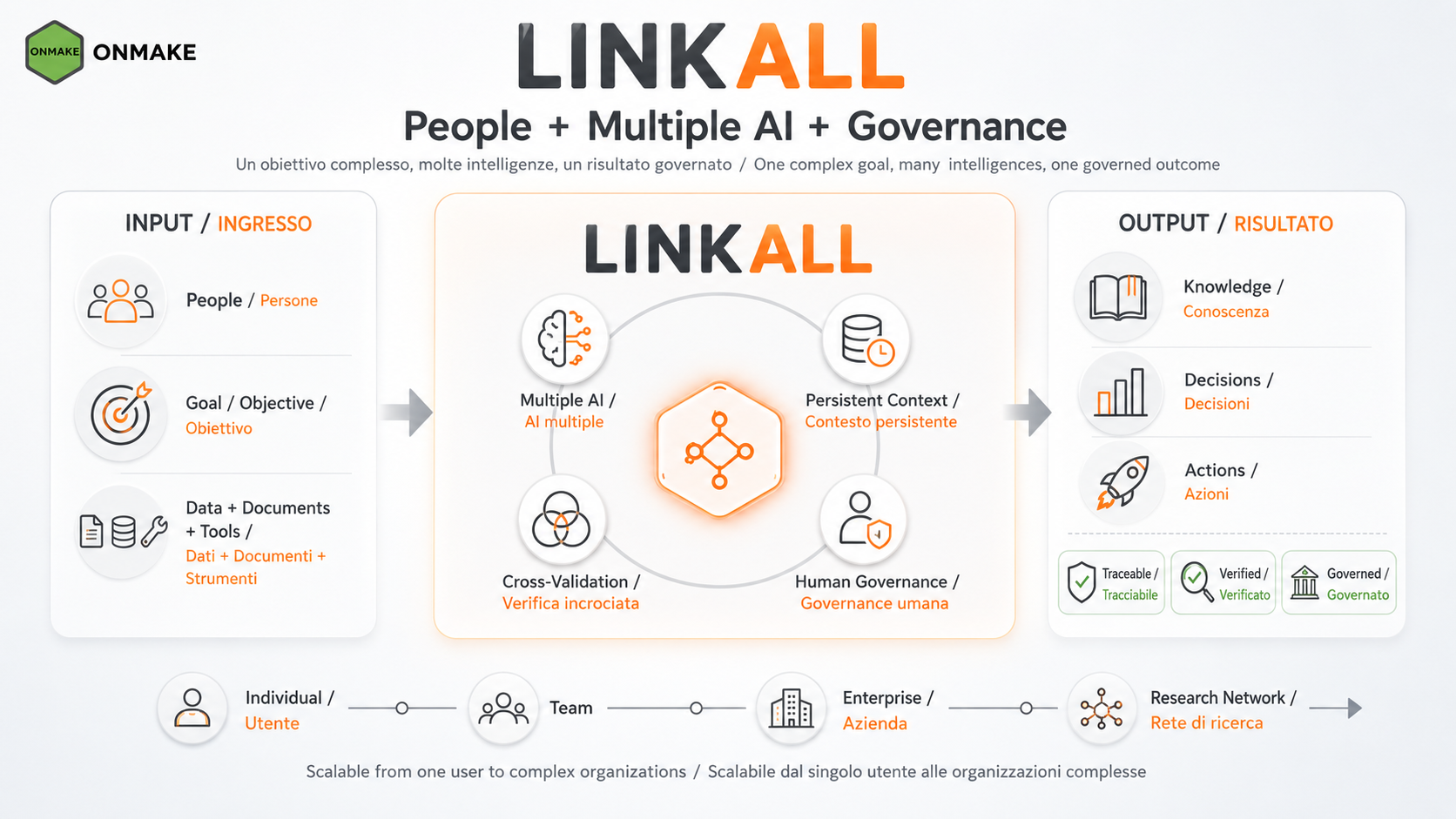
LINKALL is a cognitive environment that lets people, artificial intelligence systems, software agents, data, documents and operational tools work together as coordinated parts of one system. It exists for work that becomes too articulated to be handled effectively by one person, one AI, or a set of separate applications.
It coordinates several artificial intelligences with different skills and roles, keeps context over time, organizes information and knowledge, compares results, surfaces divergences, verifies evidence and supports building traceable decisions and solutions. Different AIs can research, analyze, design, simulate, verify, challenge and develop alternatives in the same environment, while people retain control of the process: who takes part, what they may do, what needs authorization and what stays on record.
One person can use LINKALL for research, study, design, analysis, writing, document management, brainstorming or organizing their own work. The same environment can grow progressively to coordinate teams, professional practices, research laboratories, company departments, industries and multinational organizations, without changing architecture.
The result is a system that turns many separate artificial intelligences into one coordinated working capability.
Where it is used
The same architecture applies to very different contexts. What changes is how many intelligences are coordinated, which data enters the environment and how strict the verification and governance requirements are.
Literature analysis, comparison of studies and datasets, generation and verification of hypotheses, experiment design, analysis of results and multidisciplinary collaboration. Several AIs work independently on the same problem and then compare results and evidence: the preparatory stage shortens, and time and budget shift onto the actual science. The choices remain the researchers'.
Calculation, simulation, optimization, multidisciplinary design, regulatory compliance, analysis of alternatives and document production. LINKALL can coordinate specialized AIs, technical software, data and professionals inside the same project.
Analysis of scientific and clinical literature, integration of multidisciplinary knowledge, pharmacological research, study of diseases, comparison of evidence, development and assessment of therapies, and support for complex clinical processes, preserving traceability and the authority of the healthcare professionals.
Research, documents, analysis, procedures, meetings, knowledge management, verification, planning and automation can all be handled in the same cognitive environment, with different AIs by skill and role.
LINKALL can coordinate models and AIs dedicated to production, maintenance, quality, energy, safety, supply chain, robotics, logistics and planning, relating variables that are normally analyzed by separate systems.
Passenger flows, gates, aircraft, staff, security, maintenance, logistics, weather, energy and ground transport can be analyzed by specialized components and recomposed into a coordinated view, to simulate scenarios and search for better operating configurations.
Multi-AI analysis
A single model, however powerful, has one way of reasoning and therefore one way of being wrong. Asked twice about the same problem it tends to repeat the same mistake. No amount of computing power fixes that, because it does not depend on power: what is missing is a second point of view.
When two models built differently reach the same result by different routes, that result is sounder. When they reach different results, the disagreement marks the exact point where a human check is needed. That information only comes from comparison: one model asked twice repeats its own error with the same confidence it would give the right answer.
Different models have different training and sensitivities: one catches the regulatory reference, another the numerical inconsistency, another the alternative hypothesis nobody had considered. The useful result is the reasoned sum of those different views.
In traditional workflows disagreement between sources gets lost along the way. Here it is recorded and presented: whoever is working knows where the evidence fails to converge, which in research is often the most valuable information of all.
Five lines of inquiry that would take five separate stretches of time start together. You reach the result sooner and spend less: fewer hours searching, more hours thinking. On a large corpus this is what decides which investigations are realistically feasible.
Every contribution stays attributed to the model that produced it and to the step where it was verified. In a regulated sector this is the difference between a usable result and one to be redone from scratch.
The system produces compared evidence, with its points of agreement and conflict, so that a competent person decides. The opposite of a black box that emits an answer and nothing else.
How it scales
The same architecture serves contexts of very different size. What changes is not the engine, but how many intelligences are orchestrated, how many people take part, and how strict the governance requirements are.
User
Professional
Team
Company
Large enterprise
Multinational
Research network
Individual user
One person working on more material than they can realistically get through. A few specialized AIs read, compare and verify in parallel while they think; the project context stays available months later. The gain is not writing faster: it is having a systematic second check where before there was none.
Professional practice
Complex cases and layered documentation, with several AIs working in distinct roles: one reconstructs the file, one verifies the calculations, one checks the regulatory references, one prepares the report. Whoever signs can see where every statement came from.
Research group
Literature, datasets, hypotheses and results from several people inside one environment that keeps the provenance of every piece of information. Different researchers can query the same corpus without redoing each other's work, and divergences between models stay on record.
Company
Research, documents, procedures and planning in the same environment, with separate permissions per department. Repeating processes, assessments, checks, production of standard documents, become workflows defined once and reapplied.
Large enterprise
Separate units, data that cannot circulate freely, formal accountability for every decision. What matters is context segregation between departments, the ability for one AI to access a document and another not to, and the reconstructability of who approved what: requirements that call for an environment designed for the purpose.
Big Pharma, CROs and clinical centers
The most demanding context: alongside the result you need to demonstrate how you got there. Traceability of the data used, recording of the steps, independent verification of material conclusions, explicit authorization at critical points. This is the context the architecture was designed for first, and where its constraints come from.
Every level can have its own spaces, memories, permissions, AIs, tools and governance rules.
Current AI adoption is fragmented. Users interact with single AIs in isolated chat windows, lacking long-term memory, cross-validation, or systematic governance. LINKALL™ solves this structural flaw by creating an interconnected Cognitive Ecosystem.
LINKALL connects the user to an entire fleet of AIs simultaneously (e.g., GPT, Claude, Gemini, Local Models). Each model acts as a participant in a shared workspace, contributing its strengths to complex tasks.
Users can deploy specialized AI Agents that operate asynchronously. Agents can be linked to form Multi-Agent systems where outputs are passed, reviewed, and refined in the background.
Unlike standard chats that reset, LINKALL uses Local Execution Memory (LEM) and secure document structures (BOX). AIs maintain deep contextual awareness across sessions, learning approved methodologies over time.
Generative AIs can produce incorrect statements when operating in isolation. LINKALL addresses the problem through systematic Cross-Validation: before an output reaches the user, the LINK Engine routes the draft to a secondary, distinct model (e.g. Claude checking GPT's logic). This peer-review process identifies mathematical errors, logical fallacies and factual inconsistencies, and makes divergences between models explicit instead of smoothing them over.
LINKALL is built on a simple principle: the AIs propose, the person decides. They can analyze, compare, check one another and prepare documentation even while nobody is watching. But the moment an action carries consequences, a document that goes out, a record that changes, a decision that binds, it takes an explicit authorization from whoever holds the responsibility: recorded, timestamped and traceable to a named person.
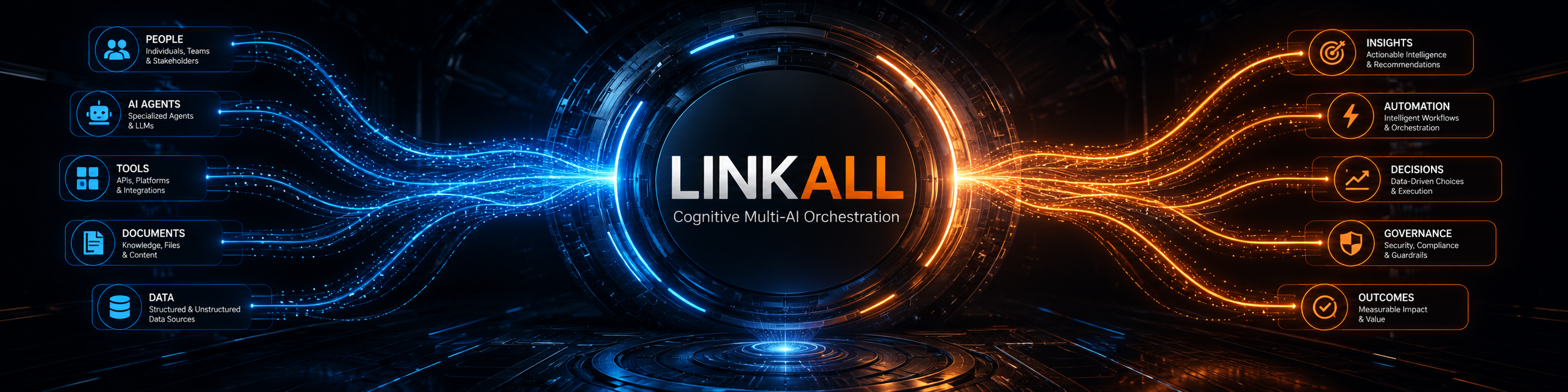
AI-generated conceptual visualization. Human-reviewed.
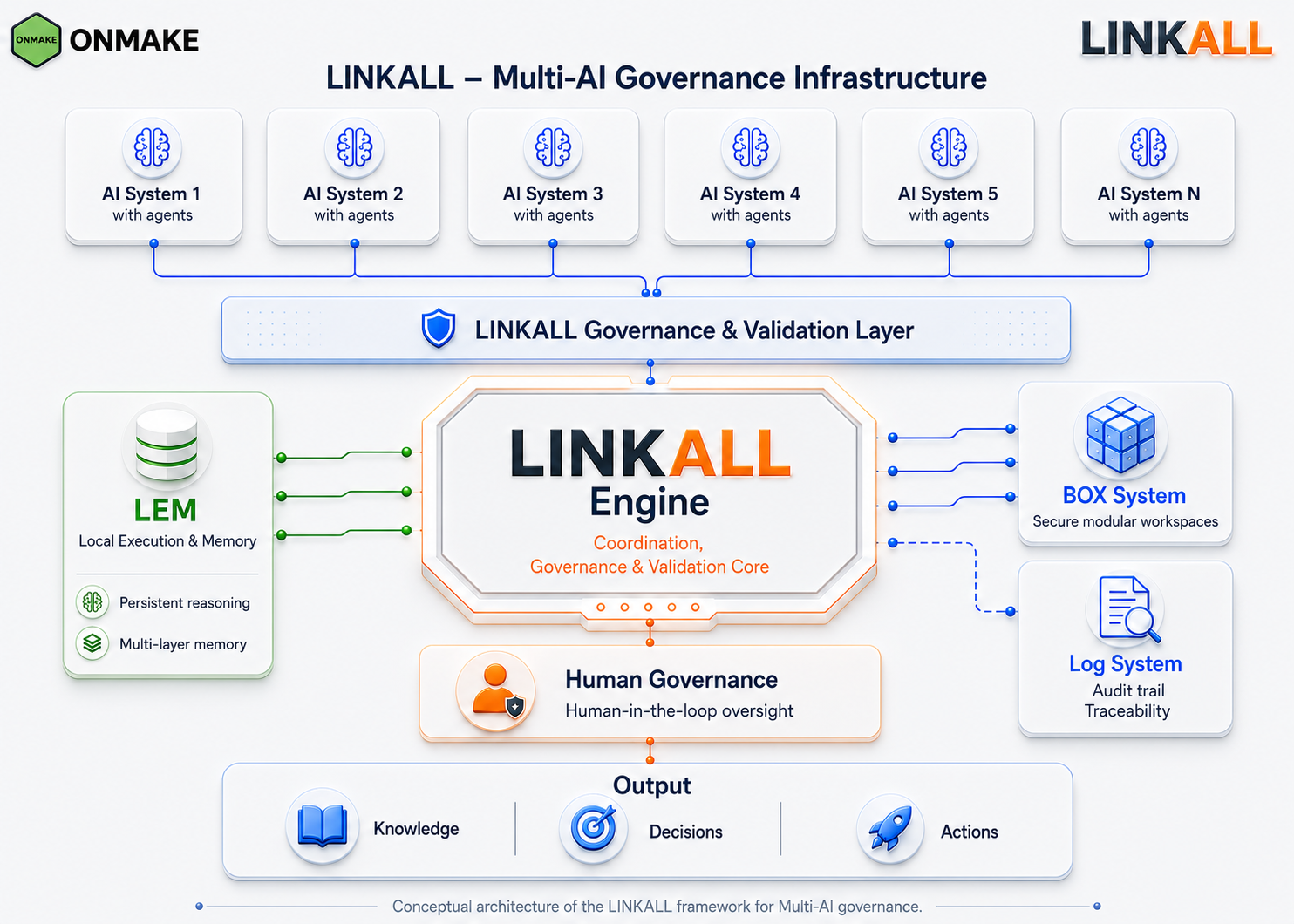
The diagram illustrates the hierarchical abstraction layers of the LINKALL™ Cognitive Operating System. Every exchange between AIs passes through LINKALL, which routes it, applies the permissions and keeps the record. The centralized Supervisor mediates every step.
U.S. Provisional Patent Application No. 63/927,664
The top layer hosts heterogeneous foundational models and their respective sub-agents. The architecture is designed to reach them through the enterprise platforms of the main providers, Google Vertex AI, Amazon Bedrock, Azure OpenAI, as well as through direct APIs and models running on the organization's own infrastructure.
The core middleware. Manages routing, asynchronous queues, context injection from LEM, and permission enforcement for the secure BOX.
The conflict resolution core. Detects logical divergences between models and asks for re-evaluation: conclusions are compared, divergences are highlighted and the synthesis stays verifiable.
The base layer holding absolute authority. The Human operator governs the process, while the audit log records every micro-transaction for regulatory compliance.
What it shows. Several models analyze the same set of data and the results are aligned and compared before they reach the researcher. This is the cross-validation step: conclusions the models agree on move forward, those they diverge on are flagged rather than smoothed over, so that a person decides which to follow.
AI-generated or AI-assisted video. Human-reviewed.
What it shows. A scenario in which the team queries the environment during the procedure and retrieves, in real time, documentation that already exists: patient data, images, reports, relevant literature, instrument readings. LINKALL retrieves it and brings it in front of whoever is operating; the assessment remains entirely the surgeon's. This is a development direction: use on a patient presupposes the qualification and validation required by medical device regulation.
AI-generated or AI-assisted video. Human-reviewed.
Confidentiality
Some data cannot leave the organization's perimeter: clinical case series, unpublished experimental results, industrial property, work under confidentiality. For these cases the architecture provides for operation in an isolated environment.
The intelligences involved can be models executed on the organization's own infrastructure, not only cloud services. Orchestration, cross-validation and governance remain the same.
Documents, internal databases and working memory can reside entirely inside the perimeter. The local execution module operates on applications already present on the machine, without exposing content outward.
The isolated configuration is designed to keep operating with no outbound connection, a recurring condition in laboratories, production areas and high-confidentiality environments.
Cloud, hybrid and local configurations answer different needs of confidentiality and computing capacity. The choice remains the organization's, not imposed by the architecture.
One of the missions
One of LINKALL™'s missions is to put Multi-AI orchestration at the service of medical and pharmacological research, prioritizing rare diseases and oncology research: fields where the relevant knowledge already exists, but is fragmented across decades of literature, dispersed among different centers and hard to correlate within the span of a research project.
The useful knowledge already exists: what is needed is a reliable way to make it talk to itself. That is where time is saved.
In rare diseases the constraint is not how much data exists, but how scattered it is: few patients, case series spread across different centers, literature layered over decades and heterogeneous journals. An architecture coordinating several specialized models can examine document corpora in parallel and correlate sources a single researcher could not realistically traverse within a project's span.
In a medical context a model's error is not a cosmetic defect. A material conclusion is therefore submitted to verification by a secondary, independent model, divergences are made explicit rather than smoothed over, and disagreement between models is treated as information useful to the researcher.
Research in regulated environments requires every conclusion to be reconstructable: which data was used, which steps were executed, which checks were performed, who approved what. The architecture is designed so this chain remains documented and inspectable, rather than reconstructed after the fact.
The AI models analyze, compare, propose alternatives and prepare documentation. Every material decision passes through the explicit approval of whoever holds professional responsibility. In a medical context that is a condition of use before it is a precaution.
It speeds up the route to the result: reading a large corpus is organized and shared across several models, with fewer hours spent searching and more spent interpreting. The researcher receives a file of evidence with the points of agreement and conflict already isolated, and remains the decision center: it is the researcher who chooses which path to follow and signs the conclusion.
Scenarios under study include support for complex clinical processes, where the environment retrieves and makes available to the practitioner the data, images and literature relevant to the case. These are development directions: use that bears on a clinical decision presupposes the qualification and validation required by medical device regulation.
Intended purpose. LINKALL™ is a tool supporting research activity and document management. Clinical assessment, diagnosis and the choice of treatment remain entirely with the healthcare professional, who retains full responsibility for them. The clinical applications described here represent research and development directions: their use on a patient presupposes the qualification and validation required by medical device regulation.
Effect on the work
LINKALL changes how work is instructed, verified and documented. Here is where that shows in daily practice.
Projects lasting months pick up where they left off. Documents, versions, decisions taken and the reasons behind them stay available and reusable, even much later.
Verification is a step built into the flow, assigned to a model distinct from the one that produced the content: it happens regardless of how much time the reviewer has.
Reports, summaries and decision records take shape during the process, as the work proceeds. In regulated sectors that is the difference between a defensible file and one to redo.
Repeating sequences, assessments, checks, production of standard documents, become workflows defined once and reapplied, instead of being reinvented each time.
On production and process data, several specialized models can analyze different aspects of the same plant and compare conclusions, rather than relying on a single reading.
A professional or a small practice can put to work an orchestration that until now was realistically available only to large organizations, with no dedicated department: they can employ orchestration that until now was realistically available only to large organizations.
LINKALL™ is under development, protected by a USPTO provisional patent application. The features described represent the designed architecture; availability and configurations are assessed case by case.
Developing this architecture takes time and resources. How it can be supported.
To use LINKALL
Find out how LINKALL can support your work, your team or your organization.
info@onmake.itIndustrial partnerships and research
Co-development, scientific validation, enterprise integration and applications on complex systems.
info@onmake.it